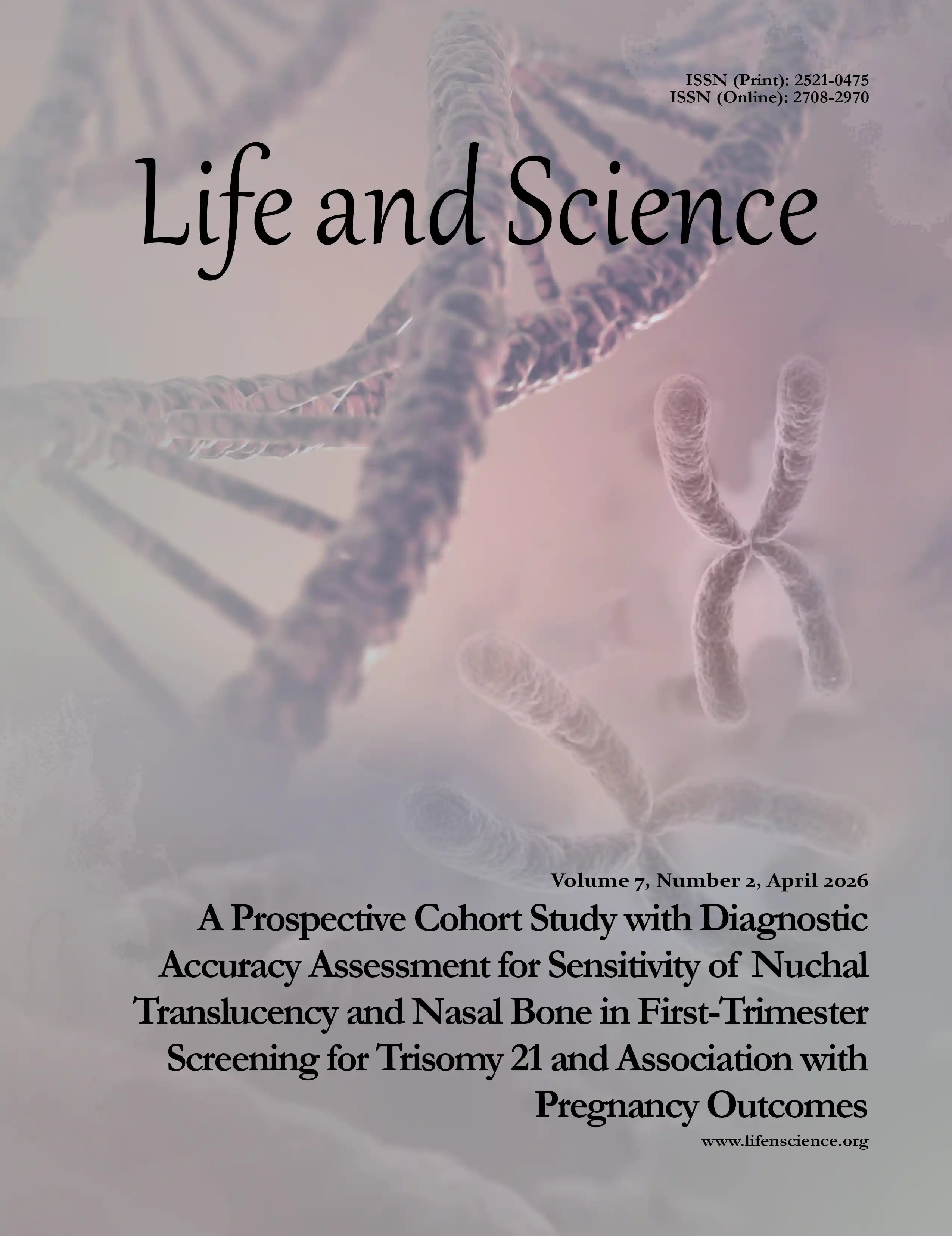
A Prospective Cohort Study with Diagnostic Accuracy Assessment for Sensitivity of Nuchal Translucency and Nasal Bone in First-Trimester Screening for Trisomy 21 and Association with Pregnancy Outcomes
DOI:
https://doi.org/10.37185/LnS.1.1.725Keywords:
Aneuploidies, Nasal Bone, Nuchal Translucency, TrisomyAbstract
Objective: To determine the sensitivity and specificity of nuchal translucency and nasal bone for detecting trisomy 21 and other poor fetal outcomes.
Study Design: A prospective cohort study with diagnostic accuracy assessment.
Place and Duration of Study: The study was conducted at the Department of Obstetrics and Gynecology, Pak Emirates Military Hospital (PEMH), Rawalpindi, Pakistan, from January 2023 to June 2023.
Methods: One hundred and fifty-four pregnant females were included. After recording medical and geographical history, a single professional performed their sonographic assessment. Fetuses having crownrump length between 45-84mm were evaluated for nuchal translucency and nasal bone. In cases of suspected aneuploidies, chorionic villus sampling was performed, and, according to the results, patients with signs of trisomy 13, 18, or 21 were advised to terminate. For fetal outcomes, a follow-up was done throughout the pregnancy. This study included females between 11 and 13+6 weeks of singleton pregnancy having CRL of 45-84mm, excluding high-order pregnancies and fetuses above 14 weeks of gestational age.
Results: Karyotype analysis revealed that 2.6% of fetuses had Trisomy 21. Among these, 3 had higher nuchal translucency thickness, and 1 had an absent nasal bone. The detection rate for Trisomy 21 was higher with increased NT (75%) than with an absent nasal bone (25%). All 4 cases of Trisomy 21 were terminated. Additionally, 3 cases with pre-eclampsia history had pre-term delivery, and 3 cases with raised NT but without Trisomy 21 experienced miscarriage.
Conclusion: In the first trimester, Increased NT was a more prevalent marker for trisomy 21 in our cohort than an absent nasal bone. The role of nasal bone assessment in this setting requires further investigation in larger studies.
How to cite this: Khail SK, Choudry A, Ashraf VN, Siraj A, Qasim R, Fareed A. A Prospective Cohort Study with Diagnostic Accuracy
Assessment for Sensitivity of Nuchal Translucency and Nasal Bone in First-Trimester Screening for Trisomy 21 and Association with
Pregnancy Outcomes. Life and Science. 2026; 7(2): 145-150. doi: http://doi.org/10.37185/LnS.1.1.725
Downloads
Published
Issue
Section
License
Copyright (c) 2026 Shumaila Khawaja Khail, Abeera Choudry, Viqar-U-Nisa Ashraf, Asifa Siraj, Rabia Qasim, Amna Fareed

This work is licensed under a Creative Commons Attribution-NonCommercial 4.0 International License.